.
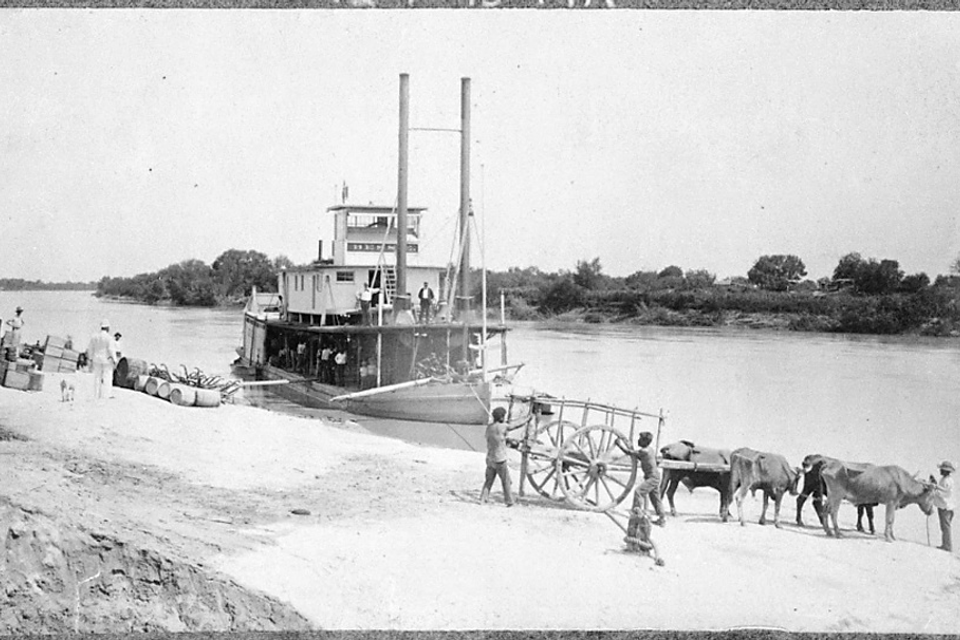
On February 19, 1871, their first child, Nora Kelly, was born in Brownsville. And on June 23, 1873, their second child, William Kelly, Jr., was born, also in Brownsville. William’s family was flourishing. But eventually, the booming steamboat hauling business dwindled to a trickle as railroad companies began to spring up. By 1874, William’s fleet of sixteen steamboats had shrunk to one small boat, ‘Bessie’, which made only two trips per month (water levels permitting) from Brownsville to Rio Grande City.
The stern-wheel steamboat "Bessie," loading
at Fort Ringgold en route to Brownsville.
Being industrious and resourceful, William turned his attention to other enterprises, including becoming director of the Rio Grande Railroad and vice-president of the First National Bank. He worked diligently in promoting the city of Brownsville as well as championing railroad construction to the frontiers of Texas and Mexico. He had the vision of connecting Brownsville to a wider area in order to expand trade and commerce. The following year, on October 15, 1875, their third child, Mary Geraldine Kelly, was born in Brownsville.
On August 23, 1878, baby Anna Rose Kelly was welcomed into the family. Like her older siblings, she was also born in Brownsville. Then a year later, in October 1879, William and Mary’s fifth and last child, John Washington Kelly, was born in Brownsville.
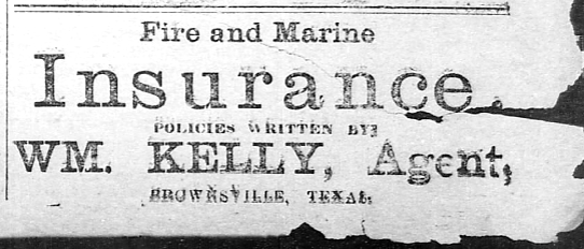
When the 1880 federal census was taken in June 1880, William had by then expanded his career to selling life insurance. He was 39 years old and Mary was 38. They were living on Washington Street in Brownsville. The Kelly household included William’s teenage stepsons, Jesse and Alfred Thornham, and all five of his younger children: ‘Norah’, William, Geraldine, Annie, and John Kelly.
In 1887, William served as the chairman of the local board of school trustees. In that role, after recognizing a desperate need for structured public education, he spearheaded a massive reorganization of the city's schools. Under his leadership, the historic Brownsville Public School (later known as the old Grammar School) was erected in 1889 to house the city's primary and high school students.
In June 1890, forty-two Union veterans were living in Cameron County, according to the Special Veterans Schedule of the 1890 federal census. William Kelly was listed among them. However, his entry includes only his name and Post Office address: Brownsville. It is interesting that the usual information - rank, service unit, and length of service, were not noted.
On June 10, 1893, eleven of those Union veterans living in the Brownsville area organized Gen. Albert M. Barney Post #67 of the Grand Army of the Republic. William Kelly was one of the eleven Charter Members and was elected by his peers as the first Post Commander. In fact, surviving records of the Department of Texas, G.A.R. show that William served multiple 1-year terms as Post Commander between 1893 and 1908. He was apparently the driving force within the Post.
William proved to be civic-minded by continuously working to promote and improve his community. For twelve years, he served as chairman of the public School Board. During his tenure, many improvements in accommodations and methods were made in the Brownsville school system. He became highly esteemed for his business integrity and social skills, becoming quite prominent and influential in Brownsville.
He was one of the founders of the First National Bank of Brownsville, and is vice president and director of the concern. He is also a leading spirit in educational matters, and the splendid public school building which Brownsville boasts was erected chiefly through his influence and activity. Most undoubted evidence of Mr. Kelly’s enterprise and desire for the development of this section has been furnished by the zeal and vigor with which he has entered into the present railroad move, giving most liberally of his own means toward it, and devoting his time to the cause unsparingly. Mr. Kelly is looked up to as one of the most highly educated and thoroughly progressive gentlemen of Brownsville, and he will prove one of the most potent factors in assuring the future prosperity and development of this section....(The Brownsville Herald, Dec 27, 1893).